Catacombs of Paris Tickets: Booking, Price and Rules
Timed tickets sell out, the route is underground and the exit is elsewhere. Here is what to book, what it costs and what to expect.
To visit the Catacombs of Paris, book a timed ticket on the official website. As of November 2026 a full-price ticket costs 31 € with an audio guide included, the museum is open Tuesday to Sunday from 9:45 to 20:30 (last admission 19:30), and it is closed on Mondays. Booking online is strongly recommended.
How do you book Catacombs tickets?
Use the official Catacombs of Paris site. The city-run museum says online booking is strongly recommended for everyone except free-rate tickets. Tickets are for a time slot, and popular slots, especially weekends, school holidays and midday, can sell out well in advance. Third-party sites sell guided visits and bundles at higher prices; a standard ticket from the official site is the baseline.
Some guides say tickets are released only a limited number of days ahead. We could not confirm that rule, so open the booking calendar for your dates and see what is on sale.
- Choose your date and time slot on the official ticket page.
- Select the rate; free and reduced rates may need proof.
- Save the ticket to your phone and arrive at the entrance a little before your slot.
How much are tickets as of November 2026?
| Visitor | Price (as of November 2026) |
|---|---|
| Adult | 31 €, audio guide included |
| Reduced rate | 25 €, audio guide included |
| Ages 8–17 | 15 €, audio guide included |
| Under 8 | Free |
The museum was renovated and reopened in 2026, and prices are higher than the figures in older guides. If a site shows 29 € or 35 €, check the date on that page.
What are the opening hours and closed days?
The museum opens Tuesday to Sunday, 9:45 to 20:30, with last admission at 19:30. Mondays are closed, and the museum also closes on some public holidays such as 1 January, 1 May and 25 December. Check the official page for exceptional closures.
What is the route like?
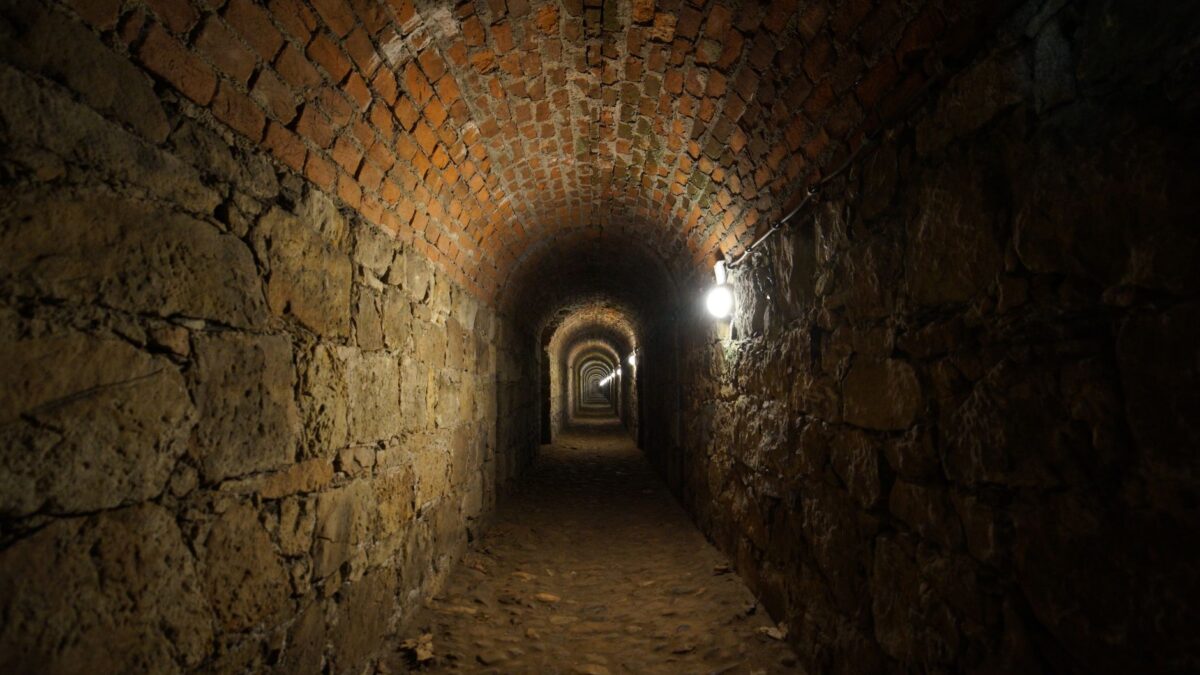
You go down a spiral staircase, walk through a gallery of tunnels that were once limestone quarries, and enter the ossuary where the bones of millions of Parisians are stacked along the walls. The ossuary was created at the end of the 18th century, when overcrowded city cemeteries were emptied and the remains moved underground. The walking route is about 1.5 km (earlier guides say roughly 243 steps in total, down and up; confirm on the official site) and takes around an hour with the audio guide.
It is not suitable for everyone. There is no lift for the stair, the passages are narrow and uneven, and the underground section has no toilets. The official page asks you to read its practical advice before visiting, and people with heart or breathing problems, claustrophobia or reduced mobility should do so carefully.
What should you wear and bring?
The tunnels are cool and damp all year, noticeably cooler than a warm Paris afternoon, and the floor can be wet. Wear closed shoes with grip and a jacket you can carry. The museum limits the size of bags carried inside, so travel light and expect a check at the entrance. Large backpacks and suitcases are not allowed; there is no luggage storage, so leave them at your hotel.
Filming rules and flash rules are posted at the entrance; follow staff instructions, since this is a burial site and people are asked to behave respectfully.
Where is the entrance and where is the exit?
The entrance is on the place Denfert-Rochereau in the 14th arrondissement, next to the metro and RER B station of the same name and the metro line 4 and 6 stops. The exit is on a different street, a short walk from the entrance, so do not leave belongings or friends waiting at the first door. Check the map on your ticket and in the practical advice on the official site, because the exit point has changed over the years.
Metro lines are covered in our guide to metro tickets and passes.
What is the history behind the Catacombs?
By the late 1700s, Paris cemeteries such as the Cimetière des Innocents were overfull and a health concern. From 1786 the remains were moved at night into disused limestone quarries south of the city, which became the ossuary. Over the following decades, workers arranged the bones into the patterns visitors see today. The quarries themselves stretch much further than the public section, and most of the network is closed to visitors.
Is a guided tour better than the standard ticket?
The standard ticket includes an audio guide and is enough for most visitors. Guided tours sold by third-party companies often add commentary, a small group and sometimes access to parts that the standard route skips, but prices are higher and not set by the museum. If you buy one, check that it includes an entry slot to the museum and read the cancellation terms. A tour is optional; it is not a way to skip the booking system.
What if the slot you want is sold out?
Check other times the same day, then neighboring days, and look again a few days before: cancellations sometimes free up slots. Early weekday mornings and the last slots of the evening are usually easier. If you are in Paris only briefly, book the Catacombs first and fit other sights around it, since this is one of the few attractions where walk-ups are not realistic.
Bottom line
Book the first slot of the day on a weekday and travel with only a light bag. Combine the visit with a walk in the 14th arrondissement afterward rather than another museum, since the cold and the stairs tire many visitors. If you have a Paris Museum Pass, check whether the Catacombs are included before you assume so, using our Museum Pass guide.
FAQ
Can I buy a ticket on the day?
Online booking is strongly recommended, and slots can be full. Do not count on buying at the door.
Is the audio guide included?
Yes, with paid tickets as of November 2026 according to the official site.
Is it safe for children?
Children from 8 pay a reduced rate and younger ones enter free, but the content and darkness are not for everyone. Parents should read the museum’s advice first.
How long does the visit last?
About an hour for the route, plus the time to queue and descend.